Overseer Denies Allegation

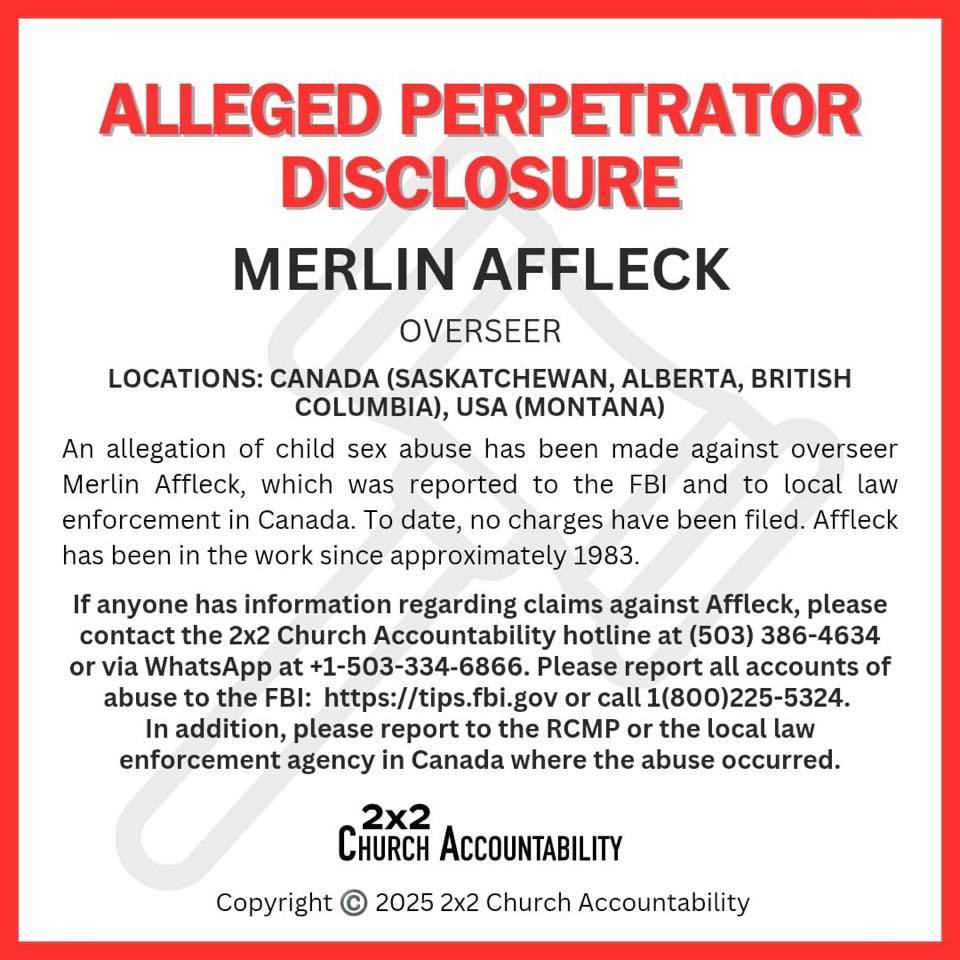
Recently an experienced investigator published an allegation against overseer Merlin Affleck (British Columbia, Canada).

WINGS did not report that allegation as our policy has been to only report court cases and convictions that are on public record (newspaper or court), as our team does not have the resources to vet all allegations and could face legal action for defamation.

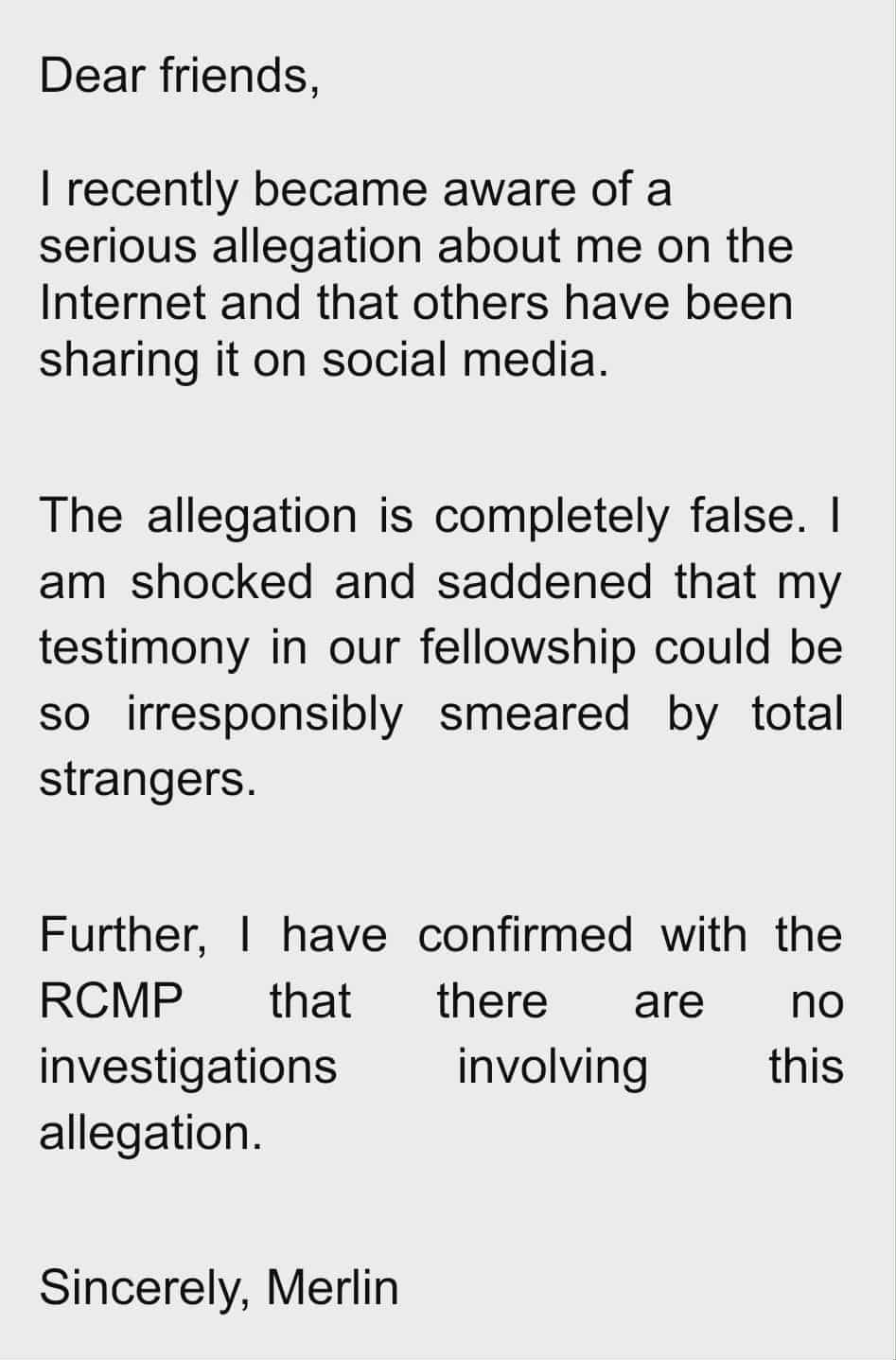
Since then, Merlin has posted a denial, stating that “the allegation is completely false”, so WINGS is now providing this commentary on those public posts.

Merlin’s post raises a number of issues.

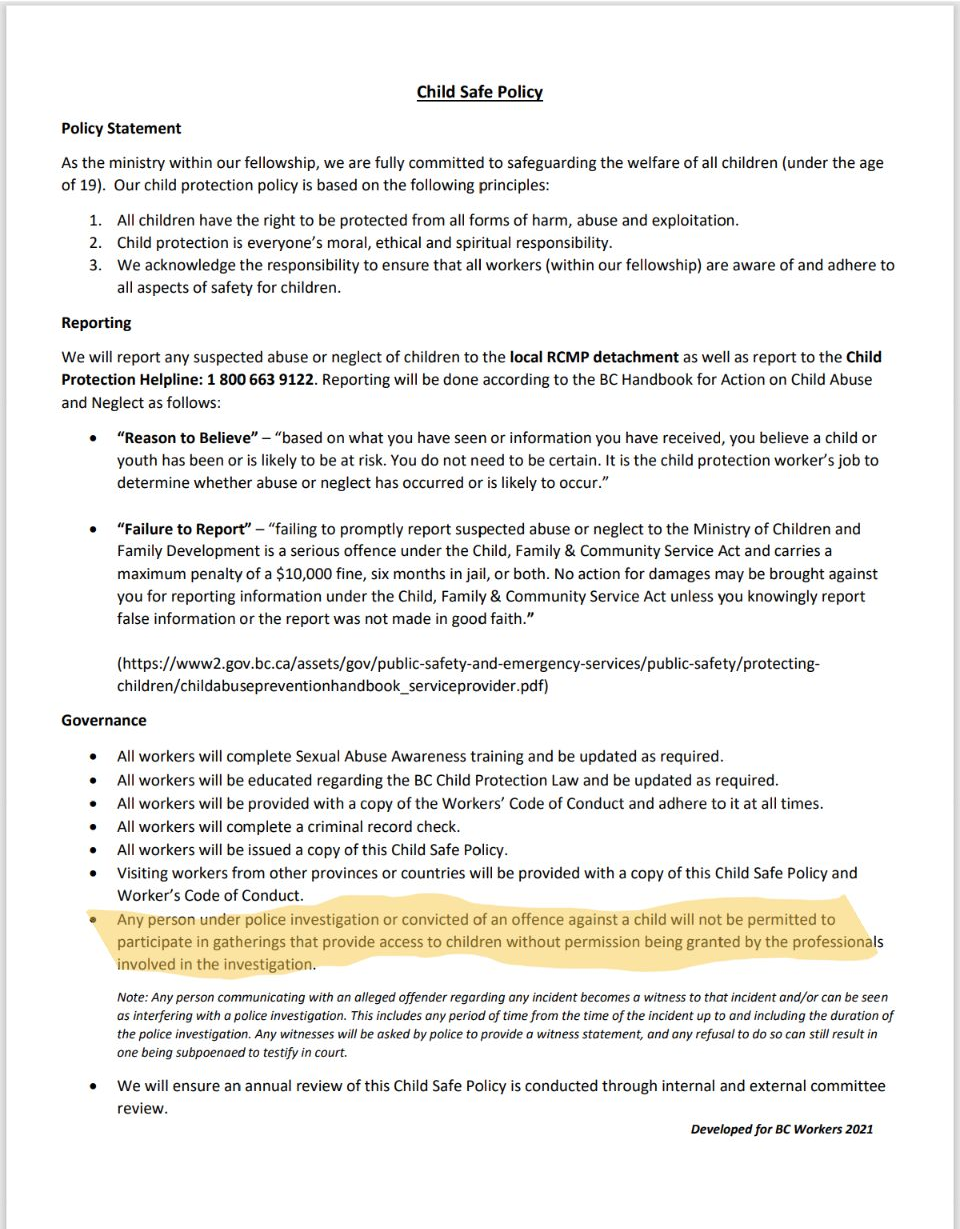
The 2021 Child Safe Policy for British Columbia states that:
Any person under police investigation …. will not be permitted to participate in gatherings that provide access to children without permission being granted by the professionals involved in the investigation.”
WINGS understand that the allegation was reported to FBI and to local law enforcement in Canada, so:

  • Did the professionals provide approval for Merlin to continue to attend gatherings where children were present (as required by the Child Safe Policy)?
  • Why was the investigation not acknowledged publicly when it was first known?
  • Why does Merlin claim that “there are no investigations involving this allegation”?
    Does he mean no current investigations?
    Does he know that FBI do not have a current investigation?
    Why didn’t he acknowledge that RCMP did undertake an investigation, even if it is now closed?

Historic cases may be difficult to prosecute or prove as there may be no corroborating evidence and it is a ‘he said / she said’ dispute. However, publishing the allegation may lead to further cases being reported, or for additional evidence being provided that may support or disprove the allegation.

This case shows that a Child Safe Policy or Code of Conduct is not sufficient to handle allegations if

  • The policy isn’t applied; or
  • Management don’t respond to allegations openly and honestly.

WINGS does not take any position about the veracity of the allegation against Merlin, but observes that failing to disclose details of allegations does not achieve a good outcome.


Funding For Victims

Many victims of abuse within the fellowship have not been able to receive the therapy they need and want because they lack the required financial resources.

Overseers have generally avoided contributing funds for victim therapy, based on various reasons, including:

  • They may be scared of legal claims against the fellowship’s accumulated funds, but surely the likelihood of that would be much lower if they readily provided funds for victim support.
  • They have claimed that funds were donated for ‘the work / workers’ and therefore shouldn’t be used for non-workers.
  • They are also reluctant to acknowledge that significant funds have accumulated.

Overseers could resolve these concerns by each area asking all current members if anyone objects to using accumulated funds for victim support.

Recently WINGS was provided the following report about funding within the fellowship. WINGS believes that it provides very relevant information and we strongly support the call to action in the final section.


How Money Works in the 2×2 Ministry

Warning: Money is an intentionally avoided topic within the Truth/2×2 church, leaving many with a false or naive understanding of how finances actually function in the Truth. This lack of transparency is deeply problematic and has real consequences. The following article may be very painful to read, especially if you have spent time in the ministry or are a victim of sexual abuse. Please proceed with care. Still, as many of us believe, “the truth will set you free.” Honest understanding is essential, even when it’s uncomfortable. As one worker told us, “we aren’t trying to hide anything,” the lack of transparency begs to differ. To be clear, none of the authors believe anything nefarious was originally intended in how large financial assets have come to be managed; it very likely started with simple practicality. However, when the outcome is highly problematic, it becomes an informed and deliberate choice when no changes are made.

The information presented here became known to the authors only recently—largely beginning in 2023—through efforts to locate funds for survivor health care and restorative justice for victims of child sexual abuse (CSA) and sexual abuse (SA) within the church. Attempts to access ministry-controlled resources were largely unsuccessful, with limited progress in Washington and some initial but abandoned efforts in Colorado and Minnesota.

This article explains how ministry finances operate to the best of our knowledge. The information was obtained through discussions with many current and former workers, as well as some individuals who have been involved with financial trusts designed for the ministry’s use. In this article, we discuss what these funds are used for, and what they are not used for. While the details vary by region, the overall financial structure is largely the same worldwide. It’s a topic that deserves a light to be shone on it, and the media already started doing exactly that.

The Reality of Ministry’s Financial Operations

While the ministry presents itself as a faith-based network of “homeless and penniless” workers, its operations are substantial and expensive. While field workers likely can be sustained by small donations (aka ‘white envelopes’) provided by the local congregation, these will not cover the larger expenses of the overall church’s operations.

Common larger ministry costs include:

  • Flights: Travel for special meetings and conventions make it clear that significant travel costs are involved. For the special meeting rounds in the Pacific Islands alone, the travel budget will very likely exceed $100,000 annually.
  • Conventions: Each typically costs over $50,000 in direct expenses such as food (even if some food and services are donated), utilities, waste management, fuel, maintenance, permits, etc.
  • Medical care: In countries without socialized healthcare, workers’ medical costs can be very expensive, especially for uninsured workers not yet eligible for Medicare (or similar programs outside of the US).
  • Overseas Housing for Workers: Colloquially called batches, used in regions where it’s impractical for workers to stay exclusively in the homes of the Friends.

Although many friends assume wealthy members cover these expenses informally, the reality is more structured. Although this may vary regionally, we understand the ministry generally relies on assets and trusts accumulated over decades to fund its operations.

How Ministry Finances Are Structured

In the early 20th century, the ministry likely operated almost entirely in cash. Starting at least as far back as the 1970s, workers began working with the Friends with financial expertise to use formal banking systems to manage large and unwieldy cash-based donations. To facilitate this, they established trusts—financial instruments legally designated for “the furtherance of the gospel.” These trusts made it far easier to accept large or entire estate donations, which soon became common, especially in the circumstances of overseers issuing formatted wording for people to give their estate ‘to the work.’

The Financial Trust Network

Money donated to the ministry is generally held in private trusts managed by custodians, often elders with professional financial backgrounds (CPAs, business owners, lawyers, etc.). While some main trusts exist at the regional level, any individual can set up a trust for ministry use and simply inform an overseer that funds are available when needed. In some cases the funds may be held by a trusted elder without any formal trust documents. Both are referred to as ‘Trusts’ in the following comments.

Because of this decentralized system, likely no one person knows how many trusts exist—there are plausibly thousands worldwide that have been created over decades. Even trust custodians often don’t know about others operating in their same region. Only overseers likely have full knowledge of all trusts that exist in their region.This is consistent with the position taken on other abuses in the ministry as well. The “I didn’t know about it so I’m not responsible” or “I was unaware of it so what am I/we to do about it?” has been a common response to the CSA crisis. Structuring a loose decentralized collection of accounts makes them hard to track & monitor. The hard truth is that this is a strategy in avoiding any responsibility and correction of abuses of all sorts and has been used to shirk CSA/SA abuses responsibility as well.

This secrecy fosters an environment where corruption is difficult to detect. For example, Dean Bruer reportedly exploited the lack of oversight by withdrawing funds from multiple trusts using the same legitimate expense justification; he then allegedly used some of this money to fund his now well-known illicit activities. The lack of checks and balances and system oversight made this easily possible.

Examples of recent financial operations

  • According to a document shared with us, UK overseer Ben Crompton distributed an estate of GBP640,000 by retaining GBP138,000 for ‘The Christian Church in England’ and distributing GBP72,000 to 6 charities and the balance of GBP430,000 to 36 elder international workers.
    • In 2023, a letter was shared from Merlin Affleck where one Canadian Trust was needing to be closed to comply with tax law, resulting in distributing $30,000 each to 4 workers and another 6 receiving smaller amounts.

These rare examples of unintended transparency provide a small glimpse of the reality of the financial scale by which the ministry operates.

Oversight and Operations

The ministry appears to function like a network of semi-autonomous franchises managed by regional overseers. Each overseer controls access to certain trusts and directs their use. When an overseer wants to fund an expense, they simply ask a trust manager to pay it—keeping themselves one step removed from direct financial transactions. It should be noted that this is an attribute in common with organized crime; that money is controlled by people who aren’t legally connected to the assets. This fact should be mortifying to both the workers and trust managers, yet they seem unfazed that this practice is still appropriate, despite FBI scrutiny.

While overseers are generally not named on the trusts directly, checks with overseers’ names on them have been shared with us in recent years. Overseers having trusts and accounts in their name was a historical practice, based on archives of codicil forms recorded in the California region under overseer Eldon Tenniswood’s leadership. Additionally, in the late 1990s in Alberta, Willis Propp was the center of a large scandal that also involved him distributing codicils to those interested in willing estates to the workers. However, in light of recent legal risks related to CSA lawsuits, we understand overseers have received legal advice to remove their names from any trust documentation for civil lawsuit liability reasons. With the precedence of $268,000 per victim on average across four settlements with the Catholic church CSA scandals, the civil liability of the ministry for restorative justice to CSA survivors would project to be enormous; likely over $1Billion based on the over 1000 perpetrators identified by the 2×2 Accountability Group and the fact that perpetrators often have many victims.

Note that overseers can deny ‘controlling’ any funds if they take a very narrow formal view of the word ‘control’ but they effectively do control the funds because the custodians / trustees only act in accordance with an overseer’s wishes. We have heard from multiple sources that the workers in California were sent a letter denying at least some aspect of the existence of financial trusts (we have not seen the actual letter, only reports that the region’s staff received such a letter this year).

Legality, Oversight, and Ethical Concerns

Are These Trusts Legal?

Yes. These trusts are lawful as long as they comply with applicable tax regulations. However, as one FBI representative told one of the authors, “No crimes happen that don’t somehow involve money.” It’s clear that the church’s financial operations are being closely scrutinized.

That said, they appear to operate in a fashion that prioritizes minimal visibility to the tax agencies. For example:

  • Of all former workers we have communicated with, the maximum amount given to them always falls under the annual gift tax exclusion limit ($19,000 per recipient in 2025 in the US). We have seen severance amounts recently often being just under this amount. Isn’t it very curious that the trust managers are very careful to keep the gift amounts below needing to be reported to the IRS? Surely workers who have spent many years in the ministry and are nearing retirement age need and deserve more than $19,000 to move forward and survive.
  • Additionally, one of the authors has first-hand experience of a trust manager’s refusal to supply the trust’s Tax ID Number when the trust was receiving a bequest. Estates are often required to make routine tax filings, and asking for the Tax ID Number of the beneficiary is a reasonable and legal request by the executor. This once again signals a priority of avoiding a trail for the IRS to follow over standard legal practice.

All the effort to avoid anything that would bring tax agency involvement is quite curious. The common scriptural justification of “Not letting the left hand know what the right hand is doing” is way different than adopting a policy of secrecy with the whole process. Charities like Bridges & Balm report out the overall finances while preserving donor and client confidentiality. Any commercial bank does the same thing. We see no reasonable excuse for the way the ministry trusts operate, both in terms of transparency with donors, and with how tax reporting events appear to dictate procedures.

Is There Corruption with these Trusts?

We are aware of credible reports of ethical misconduct, even in cases where no laws have been broken. For example, if a trust manager provides a no-interest loan to a relative using ministry funds, this may not be illegal—but it would almost certainly violate the donor’s intent. Misuses of this kind have reportedly caused serious fallout in various regions over time.

Because financial transparency within the ministry is minimal, it is difficult to determine how widespread such incidents may be. As with many aspects of church governance, the system depends heavily on trust without meaningful oversight, leaving it open to abuse.

Since law enforcement does not intervene in unethical—but technically legal—practices, reform must come from within. Real change will only occur when donors (the Friends) become informed and begin to demand transparency and accountability. These funds ultimately belong to the congregation, and with that ownership comes responsibility: failure to monitor how the money is managed makes members complicit in its misuse.

How Much Money Are We Talking About?

Exact figures are impossible to confirm without cooperation of the trust managers themselves, which has been refused at nearly every turn. Workers and elders guard financial information closely. However, multiple sources—including workers and former trust insiders—have shared some information that allows for estimating the asset scope. For instance:

  • A senior worker in one region clarified that the region’s largest trust contained between $1–10 million.
  • One region (two trusts combined) reportedly held over $50 million as of a decade ago.
  • Multiple workers have confirmed the regions they labored in had multiple accounts in the millions of dollars.

Based on a variety of information we’ve learned. We estimate that individual overseers each control access to $5–30 million in assets, with some regions far higher.

From this and other data points we’ve learned, we estimate the worldwide total of the aggregate trusts to be in the range of $500 million, though the true figure could be much greater. It could be far lower as well, particularly if funds have been mismanaged and/or suffered significant misappropriation.

Additionally, overseers have informal access to substantial private wealth from affluent members who are willing to provide money upon request. The ministry’s real financial reach, therefore, extends far beyond the trust assets alone.

Why So Much Money?

The accumulation of wealth may not have been intentional. However, since the ministry has often vilified other charitable causes – especially church-based ones – as self-serving, many members have simply willed their estates to the workers. Over decades, these estates have compounded into significant reserves, well beyond what the ministry’s operational costs could justify. With little oversight or accountability, this naturally invites power imbalances and ethical risk.

This likely explains why a senior worker recently put online an image of his premium-class seat on an international flight, which we’ve learned is not an uncommon practice. With such reserves, why not spend more than $10,000 on a flight for a convention tour or overseer meetup? Nothing wrong with this – assuming that is made transparent to those who fund the ministry – as well as to tax agencies. But since we know so many workers who have ‘gone without’ basic needs on so many occasions, this disparity is unjust and immoral.

Why the Lack of Transparency?

Transparency would directly contradict the ministry’s long-standing portrayal of its workers as “poor servants of the gospel.”  While most overseers will admit the trusts exist, they often insist that “the workers have no money,” which may be technically true if their names aren’t on the accounts—it is nonetheless dishonest and misleading.

The church has also resisted registering as a charitable organization, claiming it is “not an organization,” although this has periodically happened. For instance, a Charitable Trust was registered in Victoria, Australia by the church. Regardless, this “not an organization” posturing contradicts the church’s history of registering other legal advantages under the name Christian Conventions, such as acquiring visas or designating conscientious objector status to workers during wartime. If the ministry registered as a charity as a standard practice, it would be legally required to provide annual financial reports—the kind of transparency many donors expect.

For comparison, Bridges and Balm, a registered charity that supports CSA/SA survivors and former workers, publishes its full financial statements annually, transparency that is required by law for registered non-profits organizations.

Why Aren’t These Funds Used to Support CSA Survivors?

In a few instances, they are. For instance, the WANIDAK fund in Washington has provided significant funds for survivor therapy to date, and we understand Advocates for the Truth (AFTT) received two significant one-time donations from overseers before AFTT shut down. However, these efforts are by far the exception, not the rule. As far as we are aware, no other regions provide financial assistance to survivors of sexual abuse suffered within the church.

Overseers in Australia and New Zealand declined to provide financial support “because the government agencies provide such support,” although the reality is that the government support is very limited and difficult to access.

A notable case involved a sister worker who required expensive inpatient care after being sexually assaulted by an overseer. Four overseers in and near the regions where the assault occurred were invited to help fund her treatment. Only one responded to our request—and only to refuse, citing the assault occurred outside of his jurisdiction and therefore he couldn’t participate in the funding. Private donors ultimately covered all expenses for the former sister worker’s clinical treatment. Imagine a company employer refusing to cover care for an employee assaulted by a manager while on the job—this is the equivalent of this response from overseers. It’s a situation that would award a very large sum by any jury, should the victim choose to pursue AND the ministry’s assets could be targeted. This type of civil lawsuit was the foundation behind all of the restorative justice efforts for victims in the CSA scandals of the Catholic Church, the Southern Baptist Church, and the Boy Scout settlements. It seems quite convenient that the church’s financial assets make them safe from civil lawsuits.

What You Can Do

For Current or Former Workers

If you were denied support for basic needs or healthcare under the claim that “there isn’t money available for that,” we are deeply sorry. The information above may be painful. It should now be clear to you that such statements were made as an active choice, not due to a lack of available resources. We encourage you to advocate boldly for your needs; the resources are there.

For Current Trust Managers

If the trust is fully your money that you personally manage, please consider this information in how you choose to move forward. Please consider using your resources to aid those who have been harmed.

For those managing trusts that have inherited large sums or estates, none of this information should come as a surprise. We appeal to your integrity. You hold the power to make things right.

So far, your silence and inaction suggest a willingness to be complicit—not only in sustaining the church’s shadowy financial operations but also in obstructing restorative justice for those who have been harmed. Some of you have hidden behind the legal language of the trusts’ stated purposes, claiming that helping survivors or former workers does not align with the mission of “the furtherance of the gospel.”

We strongly disagree—and likely so would those who originally entrusted their assets to you. It is difficult to imagine that they intended their money to support only the positive aspects of the ministry while ignoring the terrible harm caused by those they funded.

For the Friends/Donors to the ministry

  • Ask for transparency. You have every right to know how donations are managed and spent.
  • Request a refund, if desired. Some overseers and trust managers have a policy of refunding donations when asked.
  • Challenge estate bequests. If your family’s estate has been left to the ministry and the heirs object, some overseers have a policy of returning all assets of the estate. Overseers and trust managers have little appetite for civil litigation.
  • Check in with elderly workers/former workers. Are they being taken care of properly, with the assets of the ministry? Or are they on SSI (elderly welfare via Social Security in the US) or other country-specific elderly welfare programs to support their basic needs? If the latter, do you find it just that they rely on public entitlements when there are sufficient church assets available to support them? Is the support they are receiving even sufficient to meet their basic needs?

Consider supporting transparent survivor-focused charities with your money instead

If you want to help survivors within the broader church community, consider:

If you want to help survivors in broader society, you have many options, and we encourage you to research and contribute to those you feel comfortable with.

An urgent appeal to overseers around the world:

We urge you to:

Immediately allocate substantial, ongoing funds for professional survivor healthcare, trauma therapy, assistance for former workers, legal aid for survivors to pursue justice, and restorative justice for survivors and former workers to help remedy the massive impact made on their overall health and livelihood.

Publicly commit to transparency in financial reporting, making survivor and former worker support a clear priority.

Structurally and transparently make financial support available to those harmed, setting a model of integrity, compassion, transparency and accountability.

This is far more than a matter of prudent stewardship—it is the defining test of your integrity and faithfulness to the principles you profess. Let it be known not for your secrecy, but for your willingness to confront the truth and bring healing. When you use your resources to address harm, you restore trust, honor donor intent, fulfill your ethical obligations, and echo the message of the gospel: that care and justice belong to all, especially the wounded and vulnerable.

You have the means. Now is the time to act.

Final Thoughts

The 2×2 ministry’s financial system is vast, opaque, and built on trust without accountability. This is leading to money being spent or withheld in ways that may be very inconsistent with the community’s moral values.  Whether you are a worker, former member, or friend, having transparency on how money moves within the ministry is essential for ensuring integrity, justice, and genuine care for those who have been harmed in the community. This is a very reasonable expectation for you to have. Thank you for your interest in learning what we, through great effort, have been able to learn.

Authors
Steve Paddon
Bruce Murdoch
Paul Svendsen
Steve Kloos

Two of the above authors are board members of Bridges and Balm.

New Canadian Initiative to Support Church Survivors

WINGS is pleased to announce the establishment of Renewal North, a Canadian assistance fund for two major needs, as identified below.  Renewal North is modeled on the US initiative Bridges and Balm, which has already done a lot of great work supporting CSA survivors and transitioning workers.

We encourage you to support these efforts.  Donations can be made through their websites here:
https://renewalnorth.org/
https://www.bridgesandbalm.org/


Renewal North

Renewal North is a Canadian non-profit corporation (currently seeking charity status) dedicated to assisting people who have been associated with the fellowship of friends and workers. This includes assisting in two identified areas of need.

CSA/SA Assistance Fund: Renewal North partners with other organizations to support survivors of child sexual abuse (CSA) or adult sexual abuse (SA) in their journey to health and healing, whether that means therapy, emotional support, housing options or other resources. Privacy and discretion will be given to all who seek help.

Transitioning Workers Fund: Assists and supports workers who are making the move from serving the ministry to living a secular life. For various reasons, there are individuals who have left or would like to leave the ministry and find themselves in need of support. This fund is an ongoing external resource, independent of the ministry, to supplement and bring relief to situations where care has been insufficient. Each applicant’s situation is different, and each will be carefully assessed to maximize resources. Assistance may be temporary financial help for immediate needs, but also help with life skills, emotional support, advice and assistance with employment, and home searching or education options.

If you or someone you know could benefit from either of these supports, please reach out. You can start by visiting the website or clicking the link for the program you are interested in. Renewal North also has links to comprehensive resources for people in crisis.

RENEWAL NORTH: https://renewalnorth.org/


Ronald Lee Schober – Repeat Offender Again

WINGS has previously reported his activities and convictions in 1977, 1982, 1987/8. See https://wingsfortruth.info/2023/05/07/ronald-lee-schober/

In 2022 Schober pleaded guilty to a charge of third-degree criminal sexual assault, relating to the rape of a mentally impaired victim at a care facility where Schober was employed as a maintenance worker.

In 2024 the Carver County District Court declined his application to withdraw his guilty plea.

In its judgement, the Court noted that he had prior out-of-state convictions for first-degree statutory rape and indecent liberties – based on the sexual abuse of five children who were his chiropractic patients.

The guilty plea deal was that Schober would plead guilty to one count of third-degree criminal sexual conduct, the other count would be dismissed, and Schober would receive a life sentence with the possibility of release after 41 months.

Schober confirmed that he understood that he was not guaranteed release after 41 months and could remain in prison for the rest of his life. The prosecution also clarified that Schober understood that he would be subject to lifetime conditional or supervised release.

The prosecution also clarified Schober’s understanding of predatory-offender registration for life.

Forgiveness and Sexual Abuse

Trigger warning: quotation of scripture, discussion of sexual abuse in a church context

Summary

This article on forgiveness presents a nuanced exploration of the concept, especially in the context of sexual abuse within church communities. It highlights that forgiveness, while a vital and restorative principle in human relationships and Christianity, has often been misused or weaponised to silence victims and avoid addressing the reality and gravity of abuse.

Key points summarized include:

  • Forgiveness is generally understood as ceasing resentment toward an offender and not seeking revenge. This works well for minor, accidental harms where repentance is present.
  • Sexual abuse, particularly child sexual abuse by adults or more powerful individuals, is very different: it involves intentional, severe harm often without repentance.
  • In cases of sexual abuse, urging victims to forgive can impose an unfair psychological and spiritual burden, suppress legitimate feelings, and discourage accountability and safety measures for offenders.
  • Forgiveness should never be demanded as a condition to avoid consequences or as a way to protect perpetrators. Doing so prioritizes offender comfort over victim wellbeing and community safety.
  • True forgiveness in such contexts is costly, complex, and deeply personal for survivors. It must not be confused with “cheap forgiveness” — a simplistic demand to forget and overlook abuse.
  • Church communities must embrace values of love, protection, and truth, supporting survivors and holding offenders accountable. Placing abuser rehabilitation or reputation over victim support damages trust and complicates recovery.
  • Forgiveness does not erase the need for justice, safety boundaries, or community responsibility.
  • The misuse of forgiveness may be seen as a form of spiritual harm or blasphemy when it becomes a tool to protect abusers under the guise of religious teaching.
  • The article calls for honest, ongoing theological and communal reflection on forgiveness, so it supports healing rather than enabling abuse or silencing survivors.

This thoughtful analysis stresses that forgiveness, while powerful, is not a quick fix or a blanket answer to sexual abuse. It must be understood and applied carefully, prioritizing survivor dignity, justice, and safety above simplistic appeals to forgive. Forgiveness is only part of a broader process of accountability, healing, and community protection.

Summary by Perplexity.ai

Note: AI was not used in the writing of this article, only for the above Summary.


Forgiveness

“Therefore, if you are offering your gift at the altar and there remember that your brother or sister has something against you, leave your gift there in front of the altar. First go and be reconciled to them; then come and offer your gift.

 Settle matters quickly with your adversary who is taking you to court. Do it while you are still together on the way, or your adversary may hand you over to the judge, and the judge may hand you over to the officer, and you may be thrown into prison. Truly I tell you, you will not get out until you have paid the last penny.”

Matthew 5:23-26

All Bible quotes are from the New International Version, sourced from https://www.bible.com/

Forgiveness can be a truly amazing thing. It can restore broken relationships, keep families functional, and probably even prevent war. It is a very important concept in Christianity and human communities in general. However, the way the word forgiveness is often used in connection with the sexual abuse of children is frustrating and harmful. I’ve seen it weaponised to oppress, silence, marginalise, and avoid dealing with real concerns about real suffering. I have experienced it used as what felt like a silencing tactic, without consideration of whether it was, in fact, absent, or even relevant to the problem we were discussing.

As described by de Vries (2023), “forgiveness is the heartbeat of salvation history and the virtue that should mark the followers of Jesus…but those who seek to control and manipulate others can twist even the very heart of the gospel for their perverted ends.” The sex abuse crisis that currently rocks the “Truth” (or the “2x2s” as they are now called in the media, for lack of an official name) has been caused (at last in part) by decades of this twisting and weaponising of forgiveness.

What is forgiveness?

I have a suspicion that when we use the word “forgive”, we’re not always talking about the same exact concept of forgiveness. One dictionary definition is:

forgive – as transitive verb

1 : to cease to feel resentment against (an offender) : pardon (eg forgive one’s enemies)

2 a : to give up resentment of or claim to requital for (eg forgive an insult)

   b : to grant relief from payment of (eg forgive a debt)

Merriam-Webster online dictionary https://www.merriam-webster.com/dictionary/forgive, retrieved 27 Nov 2024

In the context of abuse, the meaning that we usually intend is probably: “to give up resentment of or claim to requital”. Another common concept of forgiveness that I absorbed as a young person was the idea that to forgive means to decide not to seek revenge on the perpetrator – to wish them well and even pray for them, instead. We all need to thoroughly consider and clarify what exactly we mean when we use the word “forgiveness” to ensure that we are not talking past each other, or heaping impossible burdens on suffering people.

Facing up to why and how people hurt each other

We all hurt each other at some point. We can’t help it! From toddlerhood to grandparenthood, friendships, marriages, parenting, receptionists, doctors, teachers, politicians…we inevitably hurt other people in ways big or small. We learn in childhood, with the assistance of our community (hopefully), how to mend the rifts caused by our inevitable missteps through daily life.

Most of us don’t want to hurt other people and we feel bad about it when we’re aware of the impact of our actions, and we act to repair the relationship. It might be as simple as “I’m sorry! Are you OK?” after accidentally stepping on a friend’s foot, or a hasty “sorry!” when we bump the stranger in the queue with our elbow. Forgiveness is a great tool to help people mend relationships in the wake of these missteps, when repentance is present, harm is accidental, and harm is on the smaller end of the scale. Giving up resentment of the harassed, tired mother wrangling a hungry, tired toddler after she accidentally stepped on your foot at the checkout yesterday is generally a great thing for the functioning of society and everyone’s sanity and wellbeing!

However, harm can be intentional, or highly predictable, and highly damaging, and not accompanied by repentance or any concern for the impact on the recipient. This is the category I put sexual abuse in, especially the sexual abuse of children by older, more powerful adolescents or adults.

Understanding why people commit these acts is a topic that has spawned many books, articles, theories, and rehabilitation or restorative justice programs. As best I can make out after extensive research, we really don’t fully understand why people commit sexual abuse. Most of us struggle to understand why people do horrible things to other people at all. Under “Recommended Reading” at the end of this article, I have listed some books that I have read and found helpful to provide insight into why and how sexually predatory humans do what they do. I recommend the books by Hinton and Salter in particular for those needing insight into the intentions of, and harm done by, sexual predators. You won’t find definite answers to the “why” question, but useful insight.

Why preaching and discussing “forgiveness” in the context of the ongoing sexual abuse crisis in the church is problematic

Forgiveness is often mentioned in the wake of the harm done by sexual abuse, but in this context, it comes with pretty serious complications. The harassed mother in the queue is almost certainly deserving of forgiveness for standing on your foot – she was already trying not to hurt anyone, and will almost certainly try hard in future not to step on anyone else’s foot while shopping with her toddler. She can safely be let go without consequences or resentment.

The repeat adult sexual offender against small children, though…or the serial murderer…now we’re talking about something very different. The opportunist adolescent who offends once against a child while struggling to process sexual trauma of their own is a different situation again – but the harm they’ve done is likely also very far from that of the harassed foot stepping mum’s action.

Returning to our definition of “forgive” – ”to give up resentment of or claim to requital for”…when sexual abuse victims are told to forgive, because Jesus said to forgive (or the secular psychological idea that it is healthier for victims to forgive), they are usually being told to cease all bad feelings about the offender and their abusive actions AND to forgo legal pathways to consequences for the perpetrator.

Telling victims to “just forgive” their abuser, as “the answer” to “their problem” presents an issue of serious, intentional misuse of one human being by another as really an issue of an individual’s attitude to the one committing the harm. It heaps psychological and spiritual pressure on a victim to behave or feel in a certain way that may not even be possible for them (or anyone) right now (and maybe never). It sidesteps the real ongoing impact the victim must live with, and enactment of accountability and safety practices for the offender and their community.

In my opinion, from my observations and reading around sexual abuse, especially in church contexts, preaching forgiveness at sexual abuse victims is an attempt to deflect from harm done to individuals and to the community. “You just need to forgive” acts as a thought-stopping cliche (Klenk, 2025). It is an attempt to avoid making the effort to deal with such a complex and unpleasant issue. (Another similar statement which closes down discussion around sexual abuse is “I don’t want to lose my peace” (MacLernon, 2025)). Other reactions to disclosure also contribute to the internalised shame victims suffer from and do additional damage (Spring, 2021).

With or without forgiveness, psychological harm to survivors is ongoing, as is the risk of physical and psychological harm that the offender presents to future victims. Survivors have to deal with the damage done in their life, as well as personally holding the offender to account if possible, and trying to keep other possible victims safe from them. Deflecting from the work required by using forgiveness as a silencing or avoidance mechanism only puts the possible next victim in danger, rather than acting to reduce further harm by holding the perpetrator accountable and setting up boundaries to keep the vulnerable safe.

The community must wrestle with the aftermath of sexual abuse together, rather than leaving the victims alone to do the hard work and suffer from the stress of trying to save everyone around them from their offender. Many victims do forgive their offender – sometimes offenders even appear to be repentant. However, forgiveness is a personal thing, for the victim, or between the victim and God. Repentance is a personal thing and is for the perpetrator to work on, NOT the victim as abuse is NOT their fault. The existence of forgiveness and/or repentance does not alter the fact that the community must protect and support victims, and cannot predict with any accuracy whether an abuser will reoffend. Forgiveness “does not erase consequences or remove the need for justice” (Grillo, 2025). Similarly, “if forgiveness was the toleration of sin, no government could enforce the law” (Vieth, 2012).

Upon reading the recommended books about the behaviour of offenders, it will become abundantly clear to anyone that many abusers are master deceivers and manipulators and the community cannot with any certainty determine their true attitude. Be careful when offenders ask for forgiveness or claim to have repented – this can be just more manipulation of victims or for show to mislead and reassure the community.

Values and ethos of the church community

Love the Lord your God with all your heart and with all your soul and with all your mind and with all your strength. The second is this: ‘Love your neighbor as yourself.’ There is no commandment greater than these. Mark 12:30-31

By this everyone will know that you are my disciples, if you love one another. John 13:35

If I have the gift of prophecy and can fathom all mysteries and all knowledge, and if I have a faith that can move mountains, but do not have love, I am nothing.

Love is patient, love is kind. It does not envy, it does not boast, it is not proud.

It does not dishonor others, it is not self-seeking, it is not easily angered, it keeps no record of wrongs. Love does not delight in evil but rejoices with the truth. It always protects, always trusts, always hopes, always perseveres. Selected verses (2, 4-7) from 1 Corinthians 13

Using forgiveness to suppress further discussion and action regarding sexual abuse appears to prioritise the comfort of the perpetrator over those they have harmed in the past and may harm in future. When churches prioritise the feelings of alleged and convicted sex abusers, survivors see a community that is not living up to its professed moral and ethical values, and that cannot be trusted to protect the vulnerable.

Part of recovery from sexual abuse involves regaining trust and agency. Church support of abusers at the expense of victims does nothing to further this cause – in fact, it makes recovery efforts much, much more complicated and difficult. It also does very little to improve the character of the perpetrator, who may justifiably believe they have successfully taken care of the problem without further action (remorse, amends, change of church role, character development etc).

A retired Anglican priest (Parsons, 2018) described this issue using the idea of cheap versus costly forgiveness:

Cheap forgiveness and real forgiveness are two quite different currencies. The Church authorities seem in some places only to understand the first kind, the ‘forgive and forget’ option. Those who are survivors want them to begin to grapple with and understand the second kind, the incredibly costly task of moving forward with lives, even though the burden of abuse has left them with a legacy of acute pain. Somewhere, somehow, that path may eventually open itself up to the costly form of forgiveness. No one pretends that this is ever straightforward or easy. Among the many things that survivors ask from church leaders is the recognition of the difficulties of their struggle to move on and to flourish again. They ask to be considered as partners in the long journey which the whole church must take to put right the atrocious events of the past. For that, they must be regarded as allies, not as enemies to be defeated or litigants to be threatened with legal actions. Churches need all the help they can get in this undertaking. They need the survivors and perhaps in the end they need the State to help them protect children and the vulnerable from harm.

Back to values and community ethos…love, the greatest commandment of them all according to Jesus, “does not dishonor others…is not self-seeking…does not delight in evil…always protects (1 Corinthians 13). Do these values sound like those of someone who commits sexual abuse repeatedly with no downstream behaviour consistent with true repentance, or no acknowledgement of the serious harm they have done to someone else, a child victim, their family?

“Do not judge, or you too will be judged. For in the same way you judge others, you will be judged, and with the measure you use, it will be measured to you. Why do you look at the speck of sawdust in your brother’s eye and pay no attention to the plank in your own eye? How can you say to your brother, ‘Let me take the speck out of your eye,’ when all the time there is a plank in your own eye? You hypocrite, first take the plank out of your own eye, and then you will see clearly to remove the speck from your brother’s eye. Do not give dogs what is sacred; do not throw your pearls to pigs. If you do, they may trample them under their feet, and turn and tear you to pieces.”

Matthew 7: 1-6

Observant readers will notice that love “keeps no record of wrongs” (1 Corinthians 13). Other observant readers will wonder why Jesus’ command “do not judge” (Matthew 7:1-6) has not been discussed. Anyone who believes that these Bible verses rule out reporting of abuse to authorities or putting boundaries in place around sex offenders needs to consider whether they would forgo the usual police report and insurance claim when their car gets broken into and important possessions stolen. Sexual abuse is thievery on an epic, life changing scale, of future earnings, relationships, self esteem, peace, and possibly even reproductive rights and healthy functioning to name a few things. We can throw scripture bombs at each other all day but that does not prevent or ameliorate serious harm. It could be suggested that judging victims for judging sex offenders for damaging them might be rather like complaining about the speck in the victim’s eye and missing the giant plank in the perpetrator’s and congregation’s eyes.

Some relevant quotes from the book “The Devil Inside” (Hinton, 2021)

It’s strange to me when church leaders’ theology is “grace for all,” except for victims who were raped as children and have the guts to speak up about it. Many survivors have told me that they, not their abusers, were removed from church because they were “causing problems” by speaking up about their abuse and were crying out for help. Often abuse survivors are painted as “too bitter, too reactive, too emotional, and too jaded,” simply for telling the truth about the abuse. It’s no wonder that victims often don’t tell anyone when they are abused. Imagine showing up to a hospital, only to have doctors and nurses gang up on you and shame you for telling them that you are bleeding out. This response would make you want to never step foot inside a hospital again.

– Chapter 13: What I learned from consulting with churches

False foundations are why survivors are told to forgive and move on. It’s why churches keep insisting on inviting in and even hiring convicted child rapists. Literally nothing is required of the abuser while the heavy burden of forgiving and reconciling is placed on the shoulders of the abused. It makes no sense if we really understand God’s foundation of righteousness and justice. Righteousness requires people to behave righteously. Justice requires those who do not to be rebuked and kept away from anyone they intend to harm.

– Chapter 14: Theology and deception

Unforgiveness, blasphemy, and God’s reputation

Whoever is not with me is against me, and whoever does not gather with me scatters. Therefore I tell you, people will be forgiven for every sin and blasphemy, but blasphemy against the Spirit will not be forgiven. Matthew 12:30–32

One meaning of “blasphemy” is “the act of insulting or showing contempt or lack of reverence for God”.

Merriam-Webster dictionary online (merriam-webster.com/dictionary/blasphemy), accessed 26 Nov 2024

In a church setting, preaching “forgiveness” at sexual abuse victims can imply that God is on the perpetrator’s side, and doesn’t care very much about the wellbeing of those they’ve hurt (or may hurt in future). This is especially the case when the perpetrator is in the ministry or has the status of an elder, or the “forgiveness” talk comes from the ministry. Perhaps it could be considered that to use God’s Word to weaponise forgiveness against victims (thereby turning His church into a haven for child sexual abusers) in his name is actually insulting God, i.e. committing blasphemy against the Holy Spirit, the unforgivable sin. That seems worth serious consideration!

Final comments

Christianity spreads the message that if you love and forgive people they will be overwhelmed by it and decide to be better – Jesus died for your sins, follow him etc. However, love is not a magic fix for serious problems. It may well have redemptive power, but free will and choice is also at work, as well as other complicated things about the human mind and body that even the psychologists and neuroscientists are still debating and discovering.

Some things to ponder:

  • What kind of ethos do you want your community to have – or what do you believe are its values? Is it behaving in a manner consistent with these? Does the Holy Spirit really tell your community to cover up sexual abuse and blame the victims for trying to keep other children safe?
  • Where is the forgiveness of victims for being angry, sad, struggling with faith, speaking out etc, even if you really believe they are in the wrong?
  • Your assumptions that if victims are requesting boundaries for their own health, or needing to report the offending to protect others, they must have “not forgiven”, are inaccurate and hurtful. Forgiveness doesn’t help survivors sleep at night secure in the knowledge that others are safe from the offender.
  • Survivor forgiveness of their perpetrator (who harmed THEM directly, and the community indirectly) is not the same as the church community “forgiving” in a general vague sense and rehabilitating perpetrators into meetings – the degree and type of harm done differs – the congregation cannot “forgive” on behalf of the victim, or over the head of the victim! An entire article could be written on this alone.

    Please check out some of these books and articles. We all, believers or not, church members or not, 2x2s or Baptists or Catholics, have a lot of work ahead of us as a community to support survivors and make the next generation safer than we were among our people. We need to wrestle with theology around things like forgiveness rather than weaponising it or looking for quick shortcuts to deal with abuse.

Author: One of many anonymous survivors of abuse in the 2×2 church, and author of: Book Review: The Devil Inside: How My Minister Father Molested Kids In Our Home And Church For Decades And How I Finally Stopped Him

References

Recommended Books

  • Hinton, J. (2021). The Devil Inside: How My Minister Father Molested Kids In Our Home And Church For Decades And How I Finally Stopped Him. United States: Freiling Publishing.
  • Peck, M. S. (1983). People of the Lie. United States: Touchstone.
  • Salter, A. (2004). Predators: Pedophiles, Rapists, And Other Sex Offenders. United States: Ingram Publishing Services.
  • Sapolsky, R. M. (2017). Behave: The Biology of Humans at Our Best and Worst. United Kingdom: Penguin Publishing Group.

Defeating Child Sexual Abuse: Shifting to Prevention 

Child sexual abuse (CSA) devastates countless lives, far beyond the immediate pain of allegations or survivor stories. While supporting survivors is essential, the conversation must also shift toward prevention—working proactively to break the cycle of abuse before it starts. 

The Scope: Startling New Insights 

A major Australian study that surveyed 1,945 men aged 18–65 has dramatically expanded our understanding of the risks. Among the findings: 

  • 1 in 15 men admitted they would have sexual contact with a child under 14 if “no one found out.” 
  • 1 in 25 said the same regarding children under 10. 
  • Nearly 1 in 5 Australian men reported sexual feelings toward children and/or having offended. 

These statistics are deeply troubling and reveal that potential abusers are likely present—even within our trusted circles of family, friends, and colleagues. The sense of safety we feel around “respectable” individuals is often misplaced: the study found those expressing a sexual interest in children were more likely to be married, of higher income, and involved in work with children. 

Breaking the Cycle 

There is hope. A common risk factor for later abusive behavior is a personal history of CSA or other childhood trauma but it also occurs in situations where no abuse previously existed. Breaking the chain for one child may protect many more in the next generation. 

What Do Abusers Look Like? 

Popular stereotypes of predators are dangerously misleading. Most abusers are not “monsters” easily spotted in a crowd. They are frequently well-liked, helpful, and may be trusted by both adults and children. This deliberate “grooming” builds credibility while masking criminal intent. Trust also opens up opportunities for some abusers who are not deliberate predators and often the last person one would think who would abuse children. 

Two Fundamental Prevention Tools 

Many proven strategies exist to reduce child sexual abuse, but two stand out for their effectiveness and simplicity: universal vigilance and empowering children. 

1. Universal Vigilance and Awareness 

  • No exemptions. The only safe practice is to maintain vigilance around every adult, no matter how trustworthy they appear. 
  • Normalize scrutiny. Good men and caregivers must understand and accept increased caution as a vital part of protecting children. 
  • Institutional accountability. Organizations must have strict screening, supervision, and policies—abuse is most likely to occur when oversight is lax. 

2. Empowering Children 

Empowering children from a young age is critical—and research underscores the protective effect of these skills: 

Age Group Prevention Focus Example Strategies 
Under Age 3 Consent Ask before hugging, picking up, or helping; offer choices. 
Ages 3–6 Boundaries, Secrets Teach “no” to unwanted touch—even from adults; practice safe scenarios. 
Ages 5–7 and up Bodily Autonomy Emphasize, “Your body belongs to you;” rehearse speaking up. 

Keys to empowerment: 

  • Use accurate names for body parts. 
  • Teach that private parts are private, and no one may touch or see them except for hygiene or medical reasons (with a trusted adult present). 
  • Explain the difference between good secrets (surprises) and bad secrets (anything about the body or touch). 
  • Remind children they will never get in trouble for telling a trusted adult about any uncomfortable event. 
  • Role-play situations and responses so children build confidence in refusing or reporting inappropriate behavior. 

More Layers of Prevention 

While these two pillars are foundational, a multi-layered approach is best: 

  • Open communication: Frequent, age-appropriate conversations about safety, boundaries, and feelings. 
  • Supervision and involvement: Know the adults and children in your child’s life; review and verify policies and practices in child-serving organizations. 
  • Prevention education: Support or advocate for school-based programs and community education, which have shown measurable impact at scale. 
  • Support survivors: Early intervention and counseling for child victims reduces their risk of becoming abusers and improves long-term outcomes. 

Conclusion: Toward an Abuse-Free Future 

Preventing child sexual abuse requires courage, vigilance, and broad cultural change—including the willingness to have uncomfortable conversations and scrutinize even those we trust most. Many abusers were themselves abused as children so by reducing violations, we will protect the next generation. By embracing these evidence-based tools, fostering open communication, and supporting both children and adult survivors, we can weaken the cycle of abuse for generations to come. 

For further reading and resources, consult: 

Prevent Child Abuse America https://preventchildabuse.org/what-we-do/child-sexual-abuse-prevention/

Child Mind Institute: 10 Ways to Teach Children Skills to Prevent Sexual Abuse https://www.healthychildren.org/English/safety-prevention/at-home/Pages/Sexual-Abuse.aspx

RAINN: How Can I Protect My Child from Sexual Assault https://rainn.org/articles/how-can-i-protect-my-child-sexual-assault

Darkness to Light https://www.d2l.org/

Additional research from Bravehearts Australia https://bravehearts.org.au/research-lobbying/stats-facts/child-sexual-abuse-prevention-education/

Little Warriors https://littlewarriors.ca/

Stop It Now https://www.stopitnow.org/
https://www.stopitnow.org.uk/ [41 languages; Also programmes for current/potential abusers]
https://www.stopitnow.org.au/

and specially for current/potential abusers: https://www.redirectionprogram.com/ [EN and ES language]

Let’s work together to stop CSA—before it has a chance to begin.

Submitted by Bruce Murdoch. Edited for clarity by Perplexity Pro.


Raising awareness of resources available for victims/survivors of child sexual abuse & sexual abuse in the fellowship

WINGS Note: A small group in the UK/Ireland have been in touch with the Pathways to Healing and Bridges & Balm teams, and in a recent call they identified “awareness raising” as a key priority in their part of the world for now. The group put together the message below, which they are circulating through direct messages to workers and friends in the UK, Ireland and mainland Europe and by posting on social media.
They want to demonstrate that there are people in their part of the world who believe survivors and want to provide support, and also are in touch across the continents and generally of the same mind that this massive problem needs to be addressed. Some feedback on the message has been that people welcome the open communication, find it helpful to understand the goals and distinctions of the three groups named, and also notice that it is “nice to see people both former and still continuing [in the fellowship] working together.”


Over the Last two years there have been many connected to the fellowship who have disclosed sexual abuse – some still attend meetings; some no longer do. This abuse spans many decades. It is very likely there are many more who have yet to disclose their abuse, whatever form this took. It takes courage to come forward, and there are many barriers that make this particularly difficult for those associated with this fellowship.

Several groups of people in North America, comprising both current and former members of the fellowship, have worked together to set up dedicated channels of support and resources for survivors and those who are seeking to support them. These resources are for survivors at all stages of their journey, from those who are yet to come forward, to those who have disclosed and those who are healing. These resources are being shared globally and are available for anyone in Ireland, the UK and beyond. Confidentiality is assured.

We are sharing this information as a group of individuals who are concerned for the welfare of victims and survivors. You may know someone who could benefit from it and if it can be of help to just one person it will be worthwhile.

  • Pathways to Healing Network is staffed by licensed counsellors and therapists who provide safety, support, and personalised care for those healing from abuse, trauma, and betrayal in the home church fellowship. https://www.pathways2healing.org
  • Bridges and Balm is a charity whose focus is supporting the financial and emotional well- being of resting and transitioning workers as well as survivors of sexual and emotional abuse in the home church fellowship. https://bridgesandbalm.org
  • 2×2 Church Accountability is staffed by a professional investigator and retired criminal justice agents. To report abuse you may contact the 2×2 Church Accountability hotline at +1 503-386-4634 or via WhatsApp at +1 503-334-6866

A Safeguarding Policy has been developed for each of the regions within Ireland and the UK and is available from any of the local workers.
The resources listed above are independent of and separate from the Safeguarding Policies and are specially aimed at supporting those associated with the fellowship.
We would encourage victims/survivors to reach out to the Pathways to Healing Network. If criminal behaviour has occurred, you may need support in reporting to local law enforcement. You may be aware that the FBI has an ongoing investigation into child sexual abuse in the fellowship. To report abuse to the FBI go to https://tips.fbi.gov and quote 2×2 church or call +1 800-225-5324.

We hope this information will be of help.

From a group of concerned current and former members from Ireland and the UK.


Another Old Case

WINGS has recently been provided with a Court record which discloses a lot of unpleasant detail which we won’t repeat. The extracts below are published so we can acknowledge and learn from the case.

The numerous positive character references from church members, friends, family and co-workers lodged on the court docket show that we cannot assess guilt or innocence based on our personal interaction with the alleged perpetrator. The victim’s testimony may be shocking and surprising but should not be disbelieved because of our personal relationship with the alleged perpetrator.

In this case, the perpetrator admitted his guilt, but if he hadn’t, the character references could have significantly affected the apparent credibility of the victim’s claims.

This case highlights that it is essential for all of us to actively prevent abuse, and to stop and identify perpetrators instead of passively waiting for God to do what is our responsibility.


In 1988 Steven Phillip Morta of Tacoma, WA, (born January 14, 1949) was charged with two counts of Statutory Rape in the Second Degree of a child aged 11-14, a crime based on the same conduct or series of acts connected together, and/or so closely connected in respect to time, place and occasion that it would be difficult to separate proof of one charge from proof of the others.
He pleaded guilty to one count and the other was dismissed by agreement with the State.

He had been an elder in “The Way” but was no longer allowed to hold the Church meetings in his home after he was charged.

The family and friends described Mr Morta as a “loving, caring parent”; “trying to raise his children the best he could”; “tried hard to guide them and teach them good values and involve them in Church and sports.”

He was described by co-workers as an “honest, trustworthy, hard-working” individual. They described him as being helpful, highly intelligent, analytical and cooperative. They saw him as having exemplary character who is mindful of his children and an example of upstanding moral character.

His upbringing as a child was difficult which resulted in his being placed In a foster home at a young age, where he didn’t receive the nurturing and emotional support he needed, and then being in a seminary after high school for some years where his life was restricted and concepts were initiated which negatively affected his personal life. His emotional problems caused him to be hospitalized for several months when he was age nineteen.

Mr Morta reported an extensive pattern of abuse of the victim, stating that he has been abusing the child for approximately three years. He estimated somewhere around fifty to 100 different occasions with approximately ten to twelve of those occasions consisting of full intercourse.

Mr Morta was reportedly acknowledged being quite guilty and remorseful about his behavior. He recognized his errors in his thinking process as well as the damage he had done to [name redacted].

He stated that he was aware of the wrongfulness of his behavior, but “I prayed that God would forgive me for this and that I would never do it again.” He also reports that he rationalized his behavior by telling himself that it wouldn’t hurt [name redacted]. physically. Now he can identify this as a rationalization.

“I read the Bible, I want to do right, I’d go to church, it wasn’t enough to change my sexual drive”.

After willingly acknowledging his guilt and being willing to undergo therapy, Morta was sentenced in March 1988 to sixty days imprisonment, sex offender treatment, 24 months supervision, and no contact with minor females except in the presence of an adult aware of his offence. His employment with a major Seattle company was terminated.

Lessons From An Old Case

The news reports below show that Forrest Stobbe pleaded no contest to several CSA counts in 2011, but WINGS was only made aware of the details recently. Stobbe was born and raised in meetings but WINGS understands that he was not attending meetings when he was charged.
WINGS has been told that Stobbe’s name and background information is in the workers’ folder for the local field with instructions that he is not allowed to come back to meetings ever. This information has been in that folder for years, and the instructions have not changed. WINGS has been advised that he has tried to come back multiple times and been told not to repeatedly.

WINGS Observations:

  1. The precedent of blocking of this perpetrator does not seem to be followed for more recent cases, where every attempt seems to be taken for convicted perpetrators to be allowed and even encouraged to attend after completing any sentence, and for alleged perpetrators to continue fellowship until convicted.
  2. The award of damages against the school shows that overseers and other workers could be held liable where they have failed to act properly after initial reports of abuse, especially where the perpetrator has gone on to abuse other people.

Male Teacher, 41, Gets 16 Years In Prison For Molesting Boy, 10 – CBS Los Angeles (cbsnews.com)
First published on October 6, 2011 / 4:39 PM

LOS ANGELES (CBS)—A man who taught at a Los Angeles elementary school was sentenced Thursday to 16 years in prison for molesting a 10-year-old male student.

Forrest Miles Stobbe, 41, of North Hollywood pleaded no contest last month to two counts of lewd act on a child and an amended count of continuous sexual abuse of a child under 14, Deputy District Attorney Bradley McCartt said.

Stobbe – formerly a fifth-grade teacher at Queen Anne Elementary School — sexually molested the boy during the 2008-2009 school year, according to the prosecutor.

He was arrested on Aug. 4, 2009, near his home following an investigation by the Los Angeles Police Department’s Sexually Exploited Child Unit and remained jailed since then on nearly $4 million bail.


Jury awards $6.9 million to boy molested by L.A. Unified teacher – Los Angeles Times (latimes.com)

Jury awards $6.9 million to boy molested by L.A. Unified teacher
BY HOWARD BLUME
LOS ANGELES TIMES, DEC. 19, 2012 12 AM PT

A jury has awarded $6.9 million to a 14-year-old boy who was molested by a Los Angeles Unified School District teacher when he was a fifth-grade student.

The judgment, among the largest ever awarded in a district molestation case, comes at a time when L.A. Unified faces close to 200 pending molestation and lewd conduct claims arising from another teacher’s alleged conduct at Miramonte Elementary School.

Tuesday’s jury award stems from acts committed by Forrest Stobbe, a veteran teacher at Queen Anne Place Elementary School in the Mid-Wilshire area. In September 2011, Stobbe pleaded no contest to two counts of a lewd act on a child and to continuous sexual abuse of a child younger than 14. He is currently serving a 16-year sentence in prison.

The case turned on how much responsibility the school system bore, and whether district employees should have recognized warning signs that Stobbe posed a threat to the boy. Attorneys for the school system insisted that district staff acted in a professional and appropriate manner and could not have known what Stobbe was doing.

Stobbe molested the boy beginning in October 2008, when the 10-year-old was his student, and continued to abuse him through the following July, when he was arrested.

Early in the school year, Stobbe befriended the boy, earning his trust, then began to molest him in his classroom in episodes that became more brazen and invasive. He also gave the boy numerous gifts.

Stobbe also ingratiated himself with the victim’s family, buying the boy season passes to amusement parks, where he would take the boy, then molest him before dropping him off at home.

The family appreciated the teacher’s interest so much that the boy’s father asked his son if Stobbe should become his godfather. It was then that the boy told his father of the abuse, the father testified.

The evidence against Stobbe included a jar of petroleum jelly in his school desk that tested positive for the boy’s DNA. The boy told police that Stobbe used the jelly as a lubricant for sex acts.

The plaintiffs argued that there were abundant warning signs that should have alerted Stobbe’s supervisors.

More than two years before his arrest, Stobbe was observed alone with a girl in his car. He allegedly told the principal that he had parental permission to give the student a ride, but that was never verified. He also had private lunches with students in his classroom, which was against school rules.

In another incident, an angry student pushed Stobbe down a flight of stairs, injuring the teacher. The student later declined to talk to police, who consider him another possible victim.

In November 2008, a girl in Stobbe’s class complained that the teacher was making her feel uncomfortable. Stobbe, she said, was stroking her hair, putting it into a ponytail and had once touched her buttocks.

Principal Mary Ann Hall testified that she called the police department, which advised her to handle the matter on her own — a claim the Los Angeles Police Department disputes. If police had been alerted to allegations of such contact, the department would have launched an investigation, said Det. Moses Castillo, who supervised the investigation after Stobbe’s arrest.

Hall, who has since retired, testified that she properly notified her supervisors. Attorneys for the family asserted that Hall either failed to do so, or that her supervisors failed to act on the information.

In the end, the panel of six men and six women found that L.A. Unified was 30% responsible for total damages, which they calculated at $23 million. The other 70% of the liability was assigned to Forrest Stobbe, but attorneys said they had no plans to collect from the imprisoned former educator.

Responding to the verdict, a district spokesman emphasized the district’s commitment to the safety of children.

“We take our duty to protect our students seriously and are continually looking for ways that we can strengthen our screening and reporting processes to ensure that no child is ever hurt in this way,” general counsel David Holmquist said. “Although we can’t change what happened in this case, we remain committed to doing everything in our power to promote healing and improve trust with those impacted.”


Reading Between the Lines

Why We Must Expose the Language That Enables Abuse in the 2×2 Church

This Substack article was written by Alissa Klenk and is posted with her permission. WINGS found it to be instructive and valuable, particularly because it is directly connected to the F&W church and related to CSA and other abuses.


With every evasive letter released by overseers (and nearly every worker), I am disgusted by the lack of transparency and the use of carefully sanitized and vague language. This was one of the first things that I began to notice when the crisis began to unfold, and I have paid special attention to it since then.

I would say that these letters are carefully worded to avoid accountability, but I don’t think it takes much effort to write in this style because it’s so embedded in the 2×2 church culture. I don’t think anyone even realizes what they’re doing. It has become “group speak,” if you will. These language phenomena are not restricted to letter writing. It’s the preaching style of most 2×2 church workers, too.

So what exactly is wrong with the language used in these communications? And why does it matter?

Let’s break it down.

Passive Word Choice

The first red flag for me was the use of passive language in letters from overseers. As a quick overview, passive language (or passive voice) is a grammatical construction where the sentence’s subject receives the action rather than doing the action.

Here’s a simple example of passive vs. active language:

Passive: The letter was written by Larry.

Active: Larry wrote the letter.

Sometimes passive language is okay, like when we don’t know who did something. But in serious situations, like the crisis we’re in, passive language hides essential information. The language is neutral, obscures responsibility, and is insincere when discussing accountability. It makes problems seem less urgent or smaller, and can unintentionally (or intentionally) silence victims to protect the system.

Here are a few examples taken out of actual letters from the ministry:

1. “…it has been decided that…”

Let’s Analyze:

Who decided it? It’s hiding relevant information and leaves readers guessing. Not naming the decision-makers makes it seem like no one is accountable.

Active Voice Rewrite Idea:

Barry and Ray have [insert action here], in consultation with [relevant group or authority].

2. “…CSA and SA cases that have surfaced…”

Let’s Analyze:

The word choice of “have surfaced” makes it sound like these cases just randomly appeared. Abuse cases don’t just surface. The truth is, overseers have known about abuse for decades. This also downplays the courage it takes for victims to come forward and minimizes institutional responsibility.

Active Voice Rewrite Idea:

Brave survivors have come forward to report the perpetrators of child sexual abuse.

3. “There is ongoing work to continue to help in these matters.”

Let’s Analyze:

Who is doing the work? What work is being done? What does help mean? How are they helping? How long has this work/help been going on? It’s extremely vague and offers no accountability. It sounds nice, but says nothing.

Active Voice Rewrite Idea:

The ministry is working with the GRACE organization to develop clear policies that protect children and support survivors of abuse.

4. “It is being dealt with.”

Let’s Analyze:

What is being dealt with? And who is dealing with it? In situations involving harm or abuse, clarity is essential. Who is taking action and how?

Active Voice Rewrite Idea:

The ministry takes child sexual abuse allegations seriously and reports them immediately to law enforcement.

How to Identify Passive Language:

1. Look for a form of the verb “to be” + past participle

  • Examples of “to be”: is, was, were, has been, is being, had been, etc.
  • Examples of past participles: written, known, made, taken, reported, seen, etc.

The policy was created last year. → Passive

The ministry created the policy last year. → Active

  • Ask: Who is doing the action?

2. If it’s unclear or missing, it’s probably passive.

Mistakes were made. ← Who made them?

The overseer made mistakes. ← Active and clear

3. Try the “by zombies” test

If you can add “by zombies” after the verb and it still makes sense, it’s passive.

The cookies were eaten (by zombies). → Passive

Grandma ate the cookies (by zombies). → Not passive

How often do you read a letter from a worker and think, “What did that just say?” and then have to go back and read it again? This is likely the result of their use of vague, unclear, or ambiguous Language.

Unclear and Ambiguous Language

This kind of language allows for wildly different interpretations since it avoids specifics. And that’s exactly the point.

Have you ever noticed how some people will never directly address the child sexual abuse within the church, but will instead refer to it as “concerns” or “these matters”?

Even using the words CSA or SA softens the blow of a topic that’s incredibly horrible. Ambiguous language leaves the subject up to interpretation without revealing any facts. It creates the illusion of action, empathy, or leadership without creating any accountability.

Let’s look at some examples.

1. “We are trying to listen, show we care, and comfort those with concerns.”

Let’s Analyze:

On the surface, this language sounds warm and caring, but it doesn’t reveal anything. What are they listening to? How are they showing they care? What is care? What does comfort look like? And what concerns are they speaking of?

Rewrite Idea:

“We are meeting with survivors and connecting them with support through counseling referrals. We are setting up accountability processes and are working with grace to create a policy that protects children from abuse.”

2. “The ministry is united in standing against wrongdoing.”

Let’s Analyze:

Wrongdoing is an awfully sanitized word. What wrongdoing? Child sexual abuse? Coverups? Misconduct? If the language used could be applied equally to lying, theft, or child sexual abuse, it’s too vague to be useful. It mutes the seriousness of the harm.

Rewrite Idea:

“The ministry condemns all forms of child sexual abuse and has implemented a zero-tolerance policy for those who cover it up or fail to report it. The policy outlines accountability processes.”

How to Identify Ambiguous Language:

1. Look for Undefined Words or Concepts

  • Words like: “support,” “concern,” “wrongdoing,” “help,” “safety,” “steps,” “care”. These all sound good, but without definitions or examples, they can mean anything or nothing.
  • Example: “We’re offering support to those affected.”
  • Ask: What kind of support? Emotional? Legal? Financial? Counseling?

2. Look for Phrases That Could Apply to Anything

If a phrase could be copied and pasted into 100 different situations and still “fit,” it’s probably ambiguous.

  • “The matter is being addressed.” What matter? How? By whom? When?
  • “We’re committed to doing what’s right.” What is “right”? Who decides that?

3. Ask: Could Two People Read This and Understand It Differently?

Ambiguous language allows different audiences to walk away with very different interpretations, which is often the goal when leaders want to appease everyone without offending anyone.

“We continue to stand with victims.”

One reader may think this means financial or legal action. Another may think it just means feeling bad for them.

If it’s not clarified, both interpretations “work”—and that’s the problem.

4. Look for Emotionally Soothing Words Without Substance

  • Words like: “deeply grieved,” “working tirelessly,” “feeling with you,” “striving together,” “from the depths of our heart”.
  • These phrases sound heartfelt, but if they aren’t connected to real details or actions, they can be emotional filler, meant to calm without informing.

The ministry’s use of vague language has continued to erode trust and cause confusion. Read communications twice, maybe even three times, and ask yourself what’s actually being said and what are you assuming. This takes practice, especially for those of us who are so used to this vague language.

When leaders speak in euphemistic terms, they are protecting themselves and the system, not the people who have been harmed. This is especially dangerous in spiritual communities.

Spiritual Bypassing

When spiritual language is used, it deflects responsibility, minimizes harm, and allows those in leadership to avoid difficult conversations under the guise of faith, peace, or God’s will. This is called spiritual bypassing.

Here are some examples pulled straight from letters from the ministry:

1. “God is cleansing His Kingdom….the falling away must come.”

Let’s Analyze:

This is one of the worst statements being made repeatedly from the platform and throughout the friends. This statement takes a horrific situation involving real victims and reframes it as something God is doing to purify the church. The real truth? It’s shifting the focus away from the abuse coverups, placing blame on God instead as if it is His divine plan. It’s deflection.

Fix:

I don’t even think rewrites are necessary in this case, because statements like this shouldn’t even be said. Instead, the focus should be on caring for the victims.

2. “I just pray that your heart can find peace again, my dear.”

Let’s Analyze:

This was written to me directly after I wrote a letter to sister workers early on, imploring them to speak up for survivors. My concerns for survivors and for the safety of my own child were turned back on me as if I didn’t have peace in my heart. It suggests I should move on without addressing the real grief I was feeling and the reasons for it.

Fix:

Don’t use thought-stopping cliches that shame people. Instead, acknowledge the depth of pain and think analytically about what has caused these problems and how they can be fixed, rather than attributing it to spiritual failure.

3. “We are praying about guidelines.”

Let’s Analyze:

Do we really need to pray about whether or not to protect our children? The statement sounds holy, but prayer should not replace action when it comes to safety.

Fix:

Identify the specific steps to take, such as working with professionals to create safety guidelines.

How to Identify Spiritual Bypassing:

1. Watch for Scripture or God-Talk Replacing Action.

  • Examples: “We’re praying about it.” “God is in control.” “The Lord knows the heart.”

These may be sincere, but if they’re used instead of naming abuse, addressing harm, or pursuing justice, it’s spiritual bypassing.

2. Look for Redirects to “Unity,” “Peace,” or “Faithfulness.”

  • Examples: “Let’s keep our eyes on Jesus.” “We don’t want to focus on the negative.” “Let’s move forward in love.”

These phrases shut down hard conversations by making it seem unspiritual to talk about abuse, injustice, or leadership failure. They frame speaking up as a problem, rather than the harm itself.

3. Check if Victims Are Being Silenced in the Name of God.

  • Examples: “The Lord is cleansing His people.” “This is all in God’s plan.” “Only God can judge.”

These statements minimize abuse, blame victims for “bitterness,” and excuse leaders from accountability.

4. Notice If Emotion Is Framed as Lack of Faith

  • Examples: “Don’t be troubled.” “Just trust God.” “Bitterness is a sign your heart isn’t right.”

These kinds of phrases can make people feel ashamed for feeling hurt, angry, or betrayed. They twist real pain into spiritual failure, which is cruel and harmful.

I want to be clear that spiritual language is not the problem. Faith, scripture, and prayer are not the enemy—they are powerful tools of healing and hope. But when they are used to avoid truth, accountability, or justice, they become weapons of silence.

Spiritual bypassing sounds faithful, but it protects the system instead of the people harmed by it. It shifts the conversation away from truth and justice, and back onto obedience, loyalty, or “God’s plan.” When faith is used as a shield from responsibility, it stops being faith—it becomes spiritual manipulation.

Thought-Terminating Cliches

Thought-terminating cliches sound meaningful on the surface, but are actually used to shut down questions, critical thinking, or emotional responses. They’re often vague, create the illusion of wisdom or spiritual insight, but really, they half the conversation right where it should begin.

Here are a few examples in letters from the ministry:

1. “We care deeply.”

Let’s Analyze:

Statements like these got really old, really quickly for me. I am tired of hearing how much the ministry cares for us. I’d like to see some actions that prove it. “We care deeply,” sounds comforting, but it’s very vague. Why are they using “we” in a letter from an individual? If they say they care, but won’t acknowledge harm, name abusers, or take visible action to support victims, then it’s just a statement with no substance. Statements like these often appear in place of accountability. It’s a blanket statement that prevents follow-up questions.

Rewrite Idea:

“We care deeply—and here’s what we’re doing to show that care: meeting with survivors, funding counseling services, and working with abuse prevention experts.”

2. “Let’s keep our eyes on Jesus.”

Let’s Analyze:

This is a classic spiritual redirect. Of course, we want to focus on Jesus, but when this is said in response to concerns about abuse, it becomes a way to dismiss uncomfortable truths. It implies that addressing harm is a distraction from faith rather than a core part of living it. It pressures people to stay silent “for the sake of unity” or spirituality.

Rewrite Idea:

“As we look to Jesus, the embodiment of truth and justice, we are committed to confronting wrongdoing honestly and caring for the wounded among us by taking the following steps…”

3. “We’re all grieving.”

Let’s Analyze:

This phrase is sometimes used to flatten the emotional experience. Yes, many are grieving—but not all grief is the same. Survivors are grieving betrayal and trauma. Others are grieving the loss of comfort or image. Pretending these are equal creates false unity and silences people who are in deeper pain. It dismisses survivor-specific grief and replaces it with general emotional fog.

Rewrite Idea:

“While many are grieving, we recognize that the grief of survivors is uniquely deep—and we will honor that with action and change.”

Thought-terminating cliches make people feel wrong for asking questions, selfish for wanting clarity, or divisive for expecting justice. They’re a verbal smoke screen—sounding good while obscuring the truth.

If it sounds final, but says nothing, that’s your clue: it’s probably a thought-terminating cliche.

How to Identify Thought-Terminating Cliches:

1. They Shut Down Questions or Disagreement

These phrases are often used when someone raises a valid concern—but instead of engaging, the speaker ends the conversation with a “final” statement.

These aren’t always wrong, but in the wrong context, they function as conversation stoppers. They suggest that asking questions or expressing pain is unfaithful, divisive, or unnecessary.

More Examples: “God is in control.” “It’s in His hands.” “We’re all doing our best.” “Let’s not dwell on the negative.”

2. They Redirect Attention Away From the Issue

These can be used to shame people who bring up hard truths, and redirect the conversation back to spiritual performance, unity, or obedience.

More Examples: “Keep your eyes on Jesus.” “Only God can judge.” “Let’s focus on moving forward.”

3. They Flatten Complex Emotions or Experiences

These blur the distinction between survivor and abuser, bystanders and enablers, or leaders and victims. They oversimplify what needs to be confronted with nuance and care.

More Examples: “We’re all hurting right now.” “We’re all just human.” “Mistakes were made.”

4. They Make the Listener Feel Like the Problem

Instead of focusing on the harm done, these clichés shift the burden to the one speaking up—turning their valid concern into a spiritual flaw.

  • More examples: “You just need to forgive.” “Don’t be bitter.” “Be careful not to gossip.”

When I received several letters in response to my letter to sister workers, I found some common themes amongst them. They relied heavily on personal intentions over institutional transparency, framed internal dialogue and private care as adequate responses to public harm, and implied quiet care was morally superior to visible advocacy.

There’s a tendency for the 2×2 church to frame anything done publicly as attention-seeking. This is problematic when we’re dealing with child sexual abuse. Institutional change only comes from public and group advocacy, which is probably one of the reasons no real change has been implemented—there’s just not enough public support within the group to influence change.

So while the ministry relies on language tactics that are manipulative and unclear, the congregation remains silent. Language is powerful. Recognize how it’s being used and call it out. But also, use your voice to effect change and stand for the vulnerable amongst us.

Silence is too costly, especially in the face of language being used harmfully in a situation influenced by spiritual authority, emotional manipulation, and institutional self-protection. Words shape belief. They shape loyalty. They shape what we think we’re allowed to question. Don’t let vague or spiritualized language silence truth.

Speak clearly. Speak bravely. Speak up.


Author’s Note:

For the sake of transparency, I used AI fairly heavily while writing this piece—especially in the sections that define and explain different types of language. It helped with efficiency and structure, but the experiences, observations, and outrage are entirely my own.

On a related note, if you ever find yourself unsure about how a particular phrase or sentence feels or functions, try asking AI! It’s surprisingly helpful at analyzing tone, identifying vagueness, and pointing out language that dodges responsibility. Just be sure to ask thoughtful follow-up questions—and trust your gut, too.

And honestly? A few overseers might benefit from running their letters through AI before hitting “send.” It won’t fix the theology, but at least it might flag the passive voice.