A subset of members of the CSA/SA Safe Church Task Force (SCTF) scored both the rejected draft policy from the WA-NID-AK Guidelines Team as well as the policy implemented by Darry Doland and the ministry, against the safe church policy elements that the SCTF identified as necessary and also against six common loopholes found in ineffective policies.
Results:
– The draft policy from the Guidelines Team scored a perfect score, having all essential elements and none of the 6 loopholes, grading “A+”.
– The policy from the ministry scored with just 31% of the essential policy elements and 4 of the 6 loopholes, grading “substandard”.
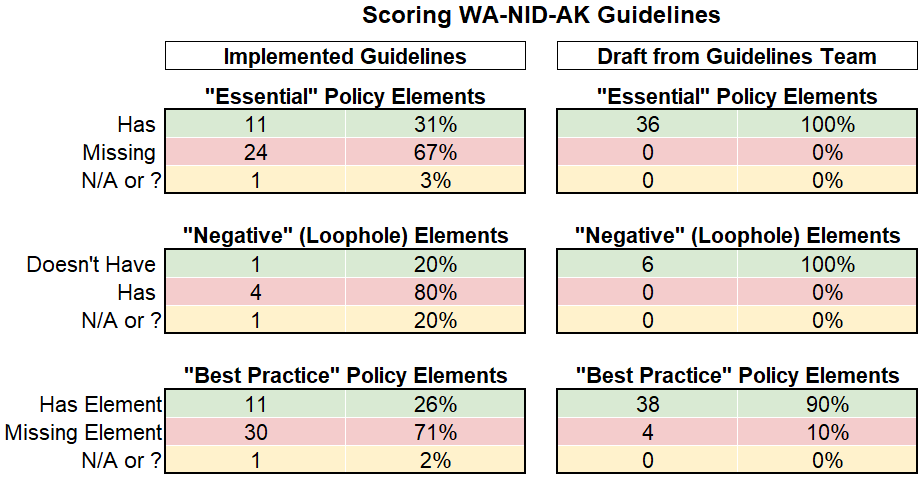
SCTF Scoring Summary
The Guidelines Team policy contains all 36 Essential elements and additionally includes two of the six additional Best Practice elements and has none of the common Negative, or loophole, elements. The Guidelines Team developed four sets of documents, including the policy (termed “guidelines”), a simple 3-page summary of the policy that would be an easy guide for the broader church members to use, a detailed 20-page FAQ document with scriptural references, and a one-page background document. The documents from the Guidelines Team exude professionalism, depth of thought, and broad consideration and are a joy and comfort to read. Our team finds them to be truly a best practice that we score an A+.
The implemented policy from the ministry is missing two-thirds of the Essential policy elements and includes none of the additional six Best Practice elements while also having four of the six Negative, or loophole, elements. While this policy does include care for victim survivors through the WaNIdAk Therapy Fund, raises awareness of CSA/SA in the ministry and the fellowship, and encourages reporting to the proper authorities, it is highly flawed. The policy gives the ministry significant latitude in decisions on abuse cases and investigations (which is a root cause of this crisis) and it will likely lead to under-reporting of abuse cases, ineffective investigations, insensitivity to victim survivors, and does not guarantee the separation of perpetrators from those that they might prey on. Our team finds it to be severely lacking and we give it the score of substandard.
SCTF Discussion
In addition to a Safe Church policy, the SCTF identified the need for a Safe Ministry Handbook, which would have two core components: a Worker Code of Conduct and a Worker Integrity & Edification Policy. Unlike a safe church policy that should be administered by a group other than the ministry, a safe ministry handbook should be administered by the ministry, for the ministry. The code of conduct section would serve as a simple, reasonable set of guidelines for worker behavior and conduct. The integrity & edification policy section would cover the vetting of prospective workers and their onboarding into the ministry, support and care for workers in their roles through regular check-ins and feedback as well as resources and support for their spiritual & emotional well being.
The policy from the Guidelines Team includes several elements that should be in a Safe Ministry Handbook while the implemented policy from the ministry includes none. For the care and support of a healthy ministry and the individuals in it, we strongly encourage the development of a safe ministry handbook.
Writing and instituting a safe church policy is a step toward becoming a safe, thriving fellowship. But a policy is only effective if it is lived and followed throughout the church without partiality or bias. A policy must be able to survive threats such as a new overseer who doesn’t agree with the need for a policy or individual workers and elders that desire to opt-out of the policy. Policy access, communication, training, and governance are critical factors in determining the effectiveness of a policy. It’s been well-shown that a policy itself does little to protect a church if it is not followed. The first weeks and months of a policy launch are critical with onboarding, education & training, and enforcement of the policy.
Many churches, youth-serving organizations, and groups that include the vulnerable have successfully implemented policies and practices that have dramatically reduced abuse while providing care and support for victims and limiting future financial and legal liabilities. This church can achieve those same positive outcomes, and the policy documents from the Guidelines team provide an excellent framework to start that journey.
A CSA/SA Safe Church Task Force presentation provides background on their vision and mission and their goal: To identify the core policy features, or elements, that enable our transformation to a safe & healthy church:
A document by a Subset of the Safe Church Task Force describing the scoring and the results can be found here:
WA-NID-AK Guidelines Scoring
The spreadsheet with the individual scores can be found here:
SCTF Scoring WA-NID-AK Guidelines & Draft from the Guidelines Team
Both documents are also provided as pdf files below:
Discover more from WINGS for Truth
Subscribe to get the latest posts sent to your email.

 WINGS for Truth
The “ministry” said they didn’t have knowledge when it came to CSA and SA, why are they meddling in this now without the expertise? They need to step aside humbly and leave it to the experts.
i agree with louise
The comparative review here is a comparison between moral clarity and moral turbidity.
I am not one bit surprised by this report. The ministry continues to believe that they are the only ones on the planet imbibed by the Holy Spirit. I continue to be SO VERY grateful for all of the caring work done by this team.
Marg Meyer/Magowan